
Baldwin
Reading for love.

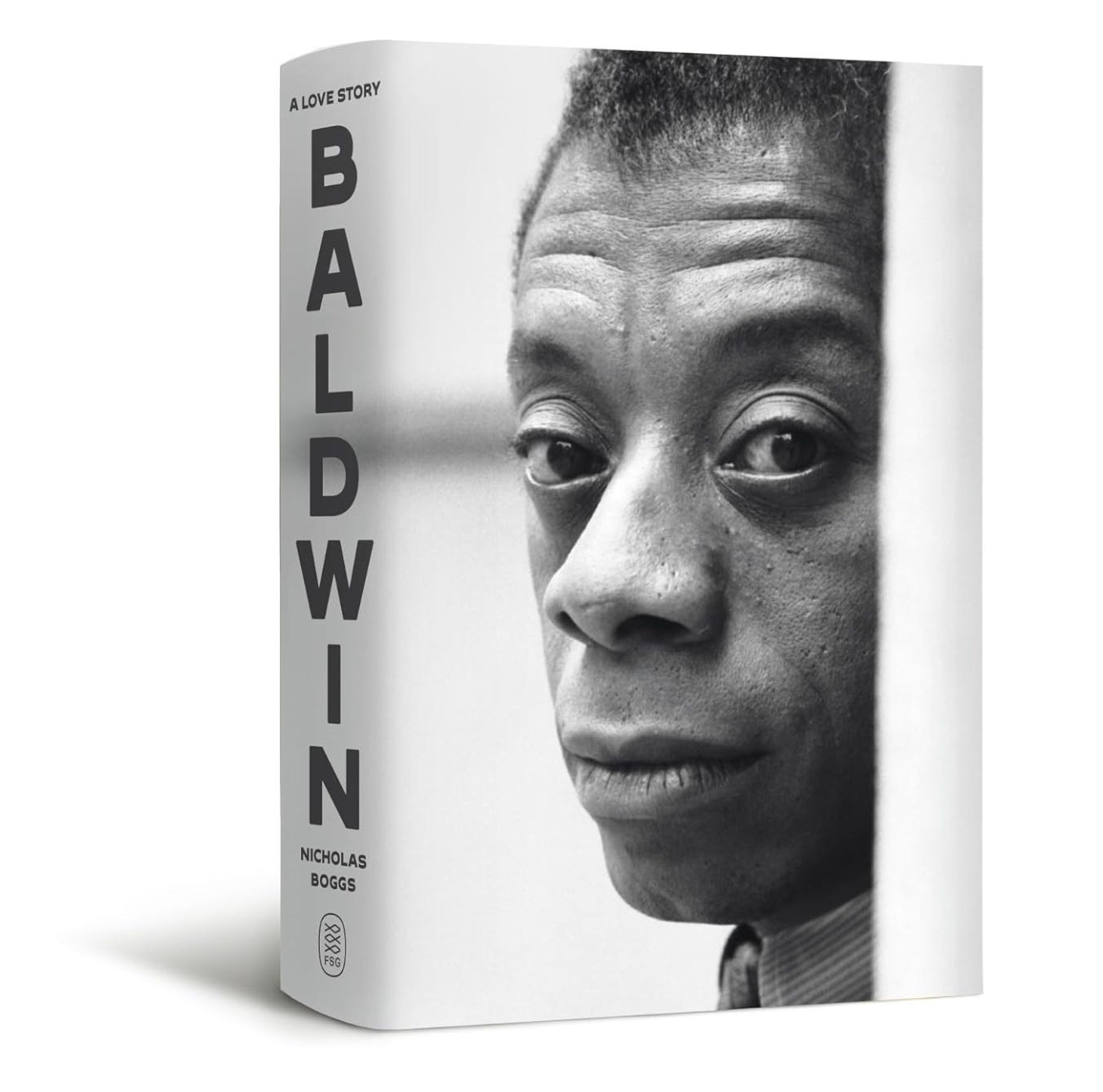
I will give you two reasons to read Nicholas Boggs’s 746-page Baldwin: A Love Story, 620 pages of which constitute the main text. I’m not suggesting the obvious reason, that is, your love of James Baldwin’s writing. Nor am I urging you to pick this soul-shaking biography over the other worthy biographies still in print because it will undoubtedly become the definitive biography. I’m not encouraging you to undertake this long book in the hope that you will come to believe, as I do, that he is the most important writer, subtle thinker, keenest observer, and humanitarian this country has ever produced. And it’s not because this account portrays his life as emblematic of the deepest, darkest contradictions and tensions in the American psyche — although it does. Instead, I want to make the case that reading this book constitutes a virtuous act in a particularly twenty-first century way.
How many people these days — you? — look forward to reading a book that is a deep, long dive into its subject? Do you enjoy works of such complexity that you need to read it straight through and in a compact period of time in order to keep the details and characters straight? Can you focus on one work of fiction or, even harder, non-fiction over 700 pages rather than usual three hundred or so pages of a typical book? I confess in recent years I find it more difficult than I used to.
To be sure, some genres targeting the non-specialist reading public — fantasy, for instance — seem to attract readers who luxuriate in convoluted epics, like J. R. R. Tolkein’s The Fellowship of the Ring, George R. R. Martin’s Game of Thrones series of novels, or Suzanna Clarke’s Jonathan Strange and Mr. Norrell. Who wouldn’t want to disappear for a long while in imaginary worlds filled with marvelous characters and creatures, anything, in fact, that takes our attention away from the godawful news. It’s just a pity so many of these imaginary worlds have moved off paper and on to the web.
Most people I know who read books regularly for work and pleasure say they have no time for long books, which I assume means they are out of the habit of reading for an entire evening. They prioritize talking to children and spouses, cooking dinner, cleaning up, followed by an hour or so of TV. Of course, this reckoning does not include the minutes we devote to checking email and our social media accounts on our phones or laptops. Most of us make less room for reading in our daily lives than we once used to.
Even professional readers struggle to keep the romance of reading alive. Academics, whose work is not confined to a 9-to-5 schedule, read books, drafts of their own work, graduate students’ disserations, theses, published articles, unpublished draft articles, student essays, personal statements, and the like after dinner. Their job takes a lot of the fun out of reading. I’m sure book editors, with their pile of manuscripts on the floor beside their armchairs, seek relief beyond the book when off duty.
In our attention-deficit economy, we are in thrall to media of one kind or another. Many of my friends can’t or won’t abstain from checking their FB feed for even a day. We seem to be powerless to withhold the one thing our cyber-masters feed and grow rich on — our attention. Zadie Smith’s recent injunction to “look away” sounds so simple and yet is so hard for us to do.1 Their platforms have become privately-owned utilities that have stunted the way we communicate with one another. I miss the time of my life when I wrote letters by hand and typewriters. I sense letter-writing is due for a comeback.
Which is why I maintain that reading Baldwin: A Love Story constitutes an virtuous act of resistance. Starting on the first page, you enter into the world of Harlem in the ‘40s, Paris in the ‘50s, the Civil Rights Movement of the ‘60s, the cultural ferment in Istanbul also in the 60s, and the heated strife of Black nationalism and gay liberation of the ‘70s. Boggs has taught me to read Baldwin through new lenses. He has given me the tools to return to his novels — I have always slighted them in favor of his essays — and extract new fuel from them. Reading all 620 pages of its text allowed me to exercise the muscle of my attention span, which has atrophied over the years I bought my first iPhone in 2008.
Lest I throw the proverbial baby out with the bathwater, without really meaning to, I found a way to enhance my reading of Baldwin. I looked at photos online and watched the many videos of James Baldwin available on YouTube. Those visual testimonies are the second reason to read the book. To see candid shots of Baldwin with his friends is to glean a little of his world. To then hear Baldwin speak, to see him flash his dazzling smile, to hear and see him take down William F. Buckley as he stood at a lectern amid a sea of white Oxford undergraduates, and to register the surprise on his face at the end of that debate when the students rose in standing ovation, turns the book into an unexpectedly immersive, interactive experience from which I did not particularly care if I ever emerged.
When I reached the section in the book in which Boggs describes Baldwin’s participation in the March on Washington, on August 28, 1963, I searched for images and on YouTube for clips of the march in which Baldwin would likely appear. Boggs writes that Baldwin was supposed to speak at the Lincoln Memorial, prior to Dr. King’s historic “I Have a Dream” oration. In the end, he did not address the crowds. Why didn’t he? Boggs found it hard to establish why, in the end, the actor Burt Lancaster ended up reading the speech Baldwin prepared. In introducing Lancaster, the actor Ossie Davis did not mention of Baldwin. Watching the video of Lancaster’s reading, I wondered, as Boggs did, what those in attendance made of that words coming from Lancaster’s mouth.2 The biographer feels certain homophobia played a starring role in process that led to removing Baldwin from the program.
Even when he was invited to participate in a panel discussion televised after the march ended, James Baldwin could scarcely be heard.3 The panel, moderated by the TV journalist David Schoenbrun, consisted of major names from the entertainment world: Harry Belafonte, Marlon Brando, Charlton Heston, Sidney Poitier, and the director and writer Joseph Mankiewicz. As the 30-minute video makes clear, Schoenbrun had an agenda. He was at pains to get the panelists to assert that the march on Washington could not have happened anywhere else in the world, especially not in Moscow. The panelists did not play along with Schoenbrun’s nudging. Rather, they began to argue.
At issue was the meaning of the phrase, “The Negro Problem,” a diagnosis bandied about in the press at that time. Poitier insisted that “the Negro problem” didn’t exist, because Black people weren’t the problem. This comment stirred Joe Mankiewicz to go further and point out that, if America had a problem at all, white Americans were it. For that reason, he believed white Americans had to take responsibility for combating inequality and prejudice. Brando immediately dismissed this out of hand. It was a human problem, he said, not a white problem or a black problem. Schoenbrun interrogated Baldwin as to whether he still hoped equality in the U.S. could be achieved without violence. Baldwin answered briefly that he hoped so and then Belafonte jumped in to turn the question about violence back on Schoenbrun. Minutes later, Baldwin managed to say a word or two of support for Mankiewicz’s point before Brando, his old friend (and possibly erstwhile lover), talked over him to express again his own conviction that the problem was global. They all spent the last minute or two disagreeing about the onus of responsibility to fight racism. Mankiewicz and Brando glanced at Baldwin once or twice as if seeking support for their positions; Belafonte, Poitier, and Heston seem indifferent to Baldwin’s presence. If you compare his eloquence in the interviews available on YouTube, Baldwin here seems diminished among this group of male rock stars — metaphorically speaking. It’s easy to forget that he, too, had recently been and perhaps still was a rock star in the literary world. In this video, we may find hints of the growing impatience with Baldwin and Martin Luther King felt by some of the more radical leaders of the Civil Rights and Black nationalist movements.
Rarely has the juxtaposition of a text, online photographs, and YouTube videos worked so well. The combined effect allows for the creation of mental holograms of Baldwin at different phases and places in his life. I see him at a Greenwich Village cocktail party, sitting on the edge of a sofa, cigarette and drink in hands, gesticulating animatedly. I picture him, again cigarette between his fingers, on a sofa in a TV studio, smiling slyly at Dick Cavett, who is asking an inept question about race. In another, he’s sitting on his shaded patio in the south of France, swinging an arm around his beloved’s shoulders while someone raises a camera to take a picture. I imagine him seated at his typewriter at the dining table in the Istanbul apartment he shares with friends. When his friend distracts him with an antic, he turns to look and laugh. I can almost hear him say “get away from me, baby.”
Boggs’s biography surprised me with its emphasis on love, not just the romantic love Baldwin felt for the four men around whom the parts of the book are arranged. I was bowled over by the love Baldwin shared with his family and friends of all stripes and colors over his too-short life. He seems to have seduced everyone he knew. This convinced me that, no matter how angry and despairing Baldwin became about his country’s refusal to change, he was always all about love.
Treat yourself to a long soak in this warm, loving bath that Nicholas Boggs has drawn. If the demands of daily life make reading 620 unduly difficult, I recommend the second best option, the conversation the journalist Michele Norris had with the author, published on her Substack, Say What?
“Zadie Smith on Politics, Turning Fifty, and Mind Control,” New Yorker Radio House, October 27, 2025. https://www.newyorker.com/podcast/the-new-yorker-radio-hour/zadie-smith-on-politics-turning-fifty-and-mind-control.
Note the sponsorship of the U.S. Information Agency.